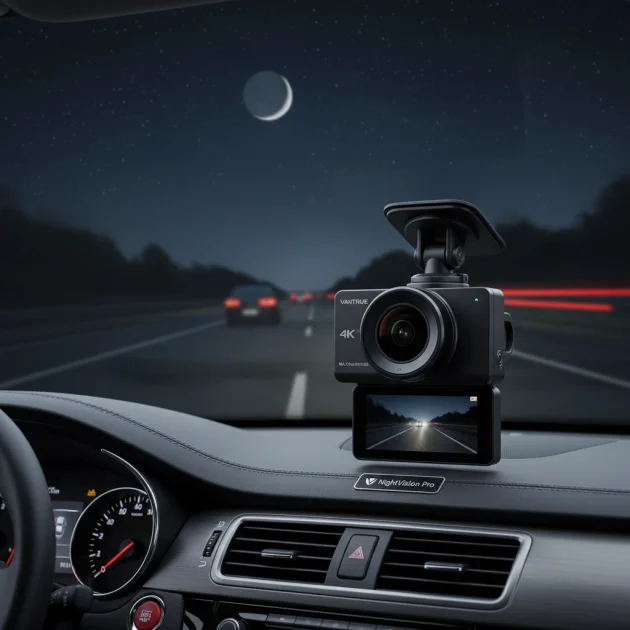
The Vantrue N4 is widely recognized as the best Vantrue dash cam for night vision, offering a triple-channel setup that excels in low-light conditions with its advanced sensors and infrared technology. This model ensures clear and detailed recordings even on the darkest roads, making it a top choice for comprehensive nighttime surveillance.
Quick comparison
| Model | Night Vision Features | Resolution | Channels | Price Range |
|---|---|---|---|---|
| Vantrue N4 | IR interior cam, Sony STARVIS | 4K+1080P+1080P | Triple | $$$ |
| Vantrue E3 | Sony STARVIS 2, F1.8 aperture | 2.5K+1080P+1080P | Triple | $$$ |
| Vantrue N2 Pro | IR interior cam, Sony STARVIS | 1440P+1080P | Dual | $$ |
| Vantrue S1 Pro | Sony STARVIS, WDR | 4K+1080P | Dual | $$ |
What night vision needs from a dash cam
Effective night vision in a dash cam relies on several key technological components. First, a high-quality image sensor, such as Sony STARVIS, is crucial. These sensors are designed to capture more light in low-light environments, significantly improving image brightness and reducing noise. Second, a wide aperture lens (e.g., F1.8 or F1.6) allows more light to reach the sensor, further enhancing low-light performance. Third, Wide Dynamic Range (WDR) or High Dynamic Range (HDR) technology helps balance exposure in scenes with both very bright and very dark areas, preventing overexposure of headlights and underexposure of dark roads. For interior recording, infrared (IR) LEDs are essential, providing invisible illumination that allows the camera to see clearly inside the cabin without distracting the driver. Finally, robust image processing software is necessary to optimize the captured data, reduce digital noise, and produce a clear, usable video.
Detailed reviews
Vantrue N4
The Vantrue N4 stands out with its triple-channel recording, offering comprehensive coverage. The front camera records in 4K, while the interior and rear cameras capture 1080P video. Its interior camera is equipped with four infrared LEDs, providing excellent night vision for cabin monitoring, crucial for rideshare drivers. The front camera utilizes a Sony STARVIS sensor, ensuring clear footage even on unlit roads. The N4’s wide dynamic range (WDR) technology further enhances its low-light capabilities by balancing exposure across varying light conditions. This model is robust, featuring a supercapacitor for reliable operation in extreme temperatures. Its parking mode options, including motion detection and collision detection, are also highly effective at night, providing continuous surveillance.
Vantrue E3
The Vantrue E3 is a premium triple-channel dash cam that improves night vision with its advanced Sony STARVIS 2 sensor in the front camera. This next-generation sensor offers superior light sensitivity and dynamic range compared to its predecessors, resulting in even clearer and more detailed nighttime recordings. The E3 also features an F1.8 aperture lens, allowing maximum light intake. Its interior camera includes infrared LEDs for crisp cabin footage in darkness. The E3’s intelligent parking mode, powered by a supercapacitor, ensures reliable monitoring when your vehicle is parked overnight. With its voice control feature, managing settings in the dark becomes effortless, making the E3 a top contender for those prioritizing cutting-edge night vision technology.
Vantrue N2 Pro
The Vantrue N2 Pro is a popular dual-channel dash cam, offering excellent value with its front and interior recording capabilities. The front camera records in 1440P, while the interior camera captures 1080P. The N2 Pro’s interior camera is equipped with infrared LEDs, making it highly effective for recording inside the vehicle at night, a key feature for rideshare and taxi drivers. Both cameras utilize Sony STARVIS sensors, which significantly enhance low-light performance, producing brighter and clearer images than standard sensors. Its compact design allows for discreet installation, and the supercapacitor ensures durability and reliability in various climates. The N2 Pro also supports various parking modes, providing peace of mind during nighttime parking.
Use cases
The best Vantrue dash cam for night vision is essential for various drivers and scenarios. Rideshare and taxi drivers benefit immensely from clear interior night vision, providing crucial evidence in case of disputes or incidents with passengers. Commuters who frequently drive in rural areas or poorly lit urban environments will find the enhanced front-facing night vision invaluable for capturing details of potential accidents or wildlife encounters. Truckers and delivery drivers operating during late hours rely on superior night vision to document their routes and any incidents on dimly lit highways. Furthermore, anyone concerned about parking lot security will appreciate a dash cam with robust night vision parking mode, which can capture clear footage of hit-and-runs or vandalism even in complete darkness, offering peace of mind.
FAQs
What makes Sony STARVIS sensors good for night vision?
Sony STARVIS sensors are specifically designed for surveillance applications, excelling in low-light conditions. They achieve this by using back-illuminated pixel technology, which increases the amount of light captured by each pixel. This results in significantly higher sensitivity and lower noise compared to conventional front-illuminated sensors. For dash cams, this means brighter, clearer, and more detailed video footage at night, allowing for better identification of license plates, road signs, and other critical details that might be missed by standard sensors.
Do all Vantrue dash cams have night vision?
While most Vantrue dash cams offer some level of low-light performance, not all are equipped with dedicated night vision features like infrared (IR) LEDs for interior recording or advanced Sony STARVIS 2 sensors. Models like the Vantrue N4, E3, and N2 Pro are specifically designed with enhanced night vision capabilities, often featuring IR lights for the cabin camera and high-sensitivity sensors for the front camera. Always check the product specifications for details on IR LEDs, sensor types, and aperture sizes if night vision is a priority.
How important is WDR for night vision?
Wide Dynamic Range (WDR) is very important for effective night vision in dash cams. At night, scenes often contain extreme contrasts, such as bright headlights or streetlights against very dark roads. Without WDR, these bright areas can become overexposed, washing out details, while dark areas remain underexposed and unclear. WDR technology processes multiple exposures to create a balanced image, ensuring that both the bright and dark parts of the scene are visible and detailed. This helps in capturing crucial information like license plates from oncoming vehicles.
Can night vision dash cams record in complete darkness?
Yes, dash cams equipped with infrared (IR) LEDs can record in complete darkness, particularly for interior cabin monitoring. The IR LEDs emit invisible light that illuminates the cabin, allowing the camera to capture clear black-and-white footage even when there is no ambient light. For exterior recording, while advanced sensors like Sony STARVIS significantly enhance low-light performance, they still rely on some ambient light (e.g., from streetlights, headlights, or moonlight) to produce color video. In absolute pitch black, exterior cameras without IR will struggle, but interior IR cameras will function perfectly.
How does a supercapacitor benefit night vision recording?
A supercapacitor is crucial for the reliability of night vision recording, especially in parking mode. Unlike traditional lithium-ion batteries, supercapacitors are more resistant to extreme temperatures, preventing overheating in hot climates and ensuring consistent performance in cold conditions. This reliability means your dash cam’s parking mode, which often relies on continuous power to monitor for incidents overnight, will function dependably. A supercapacitor ensures that the camera can safely save the last recording even if power is suddenly cut, protecting vital night vision footage.
Verdict
For drivers prioritizing exceptional night vision, the Vantrue N4 stands out as the premier choice, particularly for its triple-channel coverage and effective infrared interior camera. The Vantrue E3 offers an even more advanced solution with its Sony STARVIS 2 sensor, delivering superior clarity in low light. Both models provide reliable, detailed recordings crucial for safety and evidence collection during nighttime driving. When selecting a Vantrue dash cam, consider your specific needs for interior versus exterior night vision and the level of detail required in challenging low-light conditions.
Frequently Asked Questions
What makes Sony STARVIS sensors effective for dash cam night vision?
Sony STARVIS sensors are designed for surveillance in low-light conditions, utilizing back-illuminated pixel technology to capture more light. This results in significantly higher sensitivity and lower noise, producing brighter and clearer video footage at night for better identification of details like license plates.
Do all Vantrue dash cam models include night vision capabilities?
Not all Vantrue dash cams have dedicated night vision features like infrared (IR) LEDs for interior recording or advanced Sony STARVIS 2 sensors. Models such as the Vantrue N4, E3, and N2 Pro are specifically enhanced for night vision, often featuring IR lights for the cabin camera and high-sensitivity sensors for the front camera.
Why is Wide Dynamic Range (WDR) important for night vision recording?
Wide Dynamic Range (WDR) is crucial for effective night vision because it balances exposure in scenes with extreme contrasts, such as bright headlights against dark roads. WDR technology processes multiple exposures to create a balanced image, ensuring both bright and dark areas are visible and detailed, which helps capture critical information like license plates.
Can dash cams with night vision record in complete darkness?
Yes, dash cams equipped with infrared (IR) LEDs can record in complete darkness, especially for interior cabin monitoring. The IR LEDs emit invisible light, allowing the camera to capture clear black-and-white footage without ambient light. Exterior cameras with advanced sensors like Sony STARVIS enhance low-light performance but still rely on some ambient light for color video.
How does a supercapacitor improve night vision recording reliability?
A supercapacitor enhances the reliability of night vision recording, particularly in parking mode, by being more resistant to extreme temperatures than traditional lithium-ion batteries. This ensures consistent performance in hot or cold climates, allowing the dash cam's parking mode to function dependably overnight and safely save recordings even if power is suddenly cut.
Get our weekly buyer guide
Practical specs, not advice. Unsubscribe anytime.
I finally pulled the trigger on the Vantrue N4 after reading about its triple-channel setup. The night vision is seriously impressive, especially with the IR interior cam. I drive a lot for work, often late, and having that extra peace of mind knowing everything is being recorded clearly, even inside the car, is a game-changer. Definitely worth the investment for the quality.
The Vantrue S1 Pro has been fantastic for my daily commute. The WDR feature really helps when I’m driving against headlights at night, preventing those blown-out areas. I appreciate the 4K front camera resolution too; details are super crisp. It was easy to install and has been completely reliable so far.
I got the Vantrue N2 Pro because it was in my price range and had the dual channel setup with IR. For the most part, it’s good, especially the front camera’s night vision. However, I was hoping for a bit more clarity from the interior camera in really dark conditions. It’s okay, but not as sharp as I expected based on some of the reviews I read about the Sony STARVIS. Still, it’s a solid dash cam for the price.
I’ve been using the Vantrue E3 for a few weeks now, and the Sony STARVIS 2 sensor really does make a difference. My old dash cam struggled in dimly lit parking lots, but this one captures everything so much better. The F1.8 aperture probably helps too. My only minor gripe is that the menu system took a little getting used to, but once you figure it out, it’s fine.